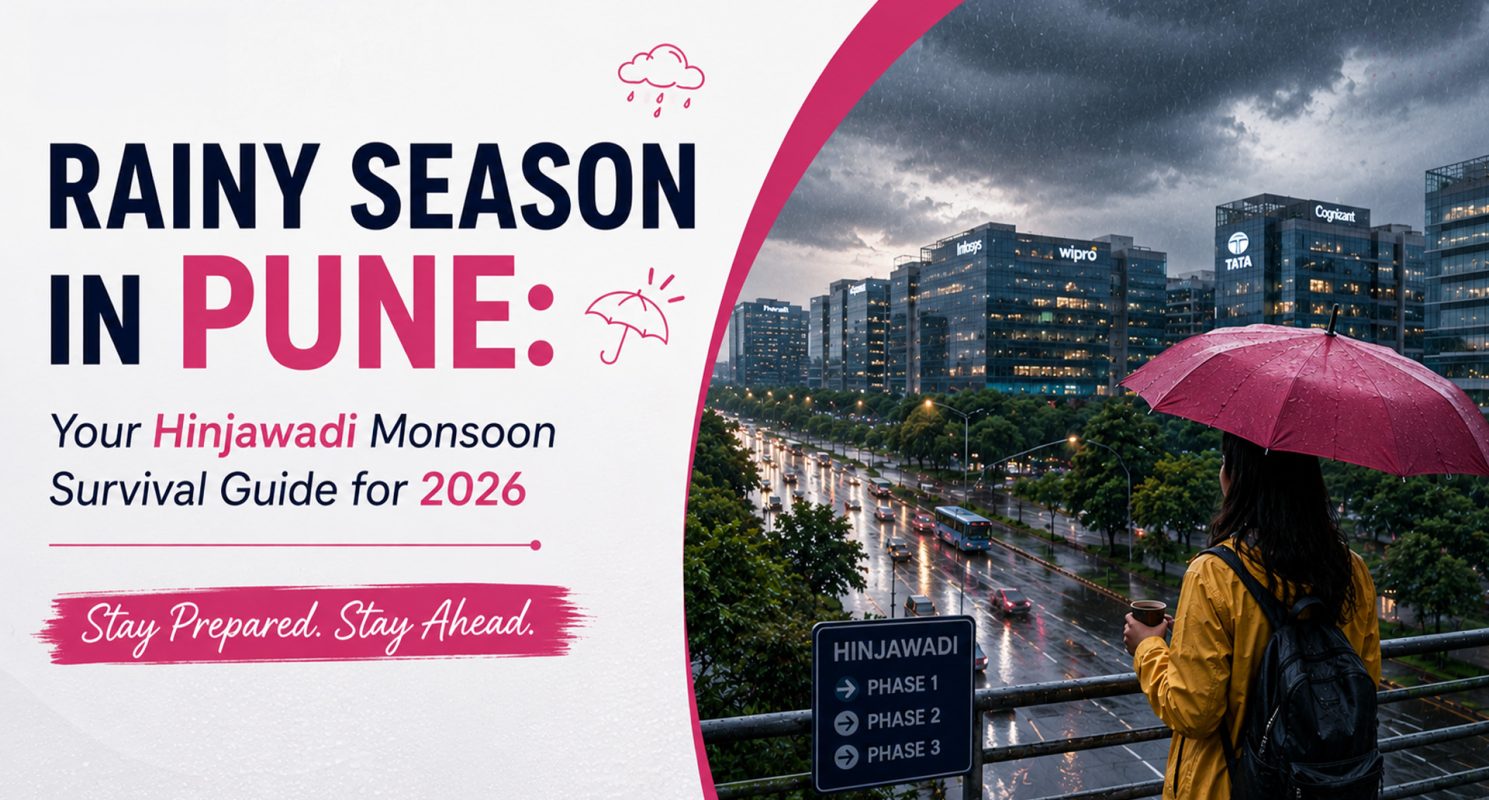
That first heavy downpour always catches new Hinjawadi residents off guard. The Mumbai-Bangalore Highway underpass near Wakad transforms into a 20-30cm-deep water trap by 8:30 AM, your usual 20-minute commute to TCS balloons to 50 minutes, and suddenly that two-wheeler you relied on becomes useless on Pashan-Hinjewadi Road, where waterlogging hits 1 meter deep.
Here’s your complete guide to navigating the rainy season in Pune, specifically tailored for professionals living near Hinjawadi. From understanding exactly when and where flooding disrupts your commute to choosing neighborhoods that won’t leave you stranded, this is the hyperlocal breakdown the welcome email from HR never mentioned.
What Actually Happens During Pune’s Rainy Season
Pune’s monsoon runs from June through September, with July being the wettest month at 340mm of rainfall. June kicks off with temperatures dropping to 22-29°C and high humidity that makes the air feel thick, punctuated by sudden thunderstorms that test whether you’re prepared or panicked.
The 2026 outlook? The IMD forecasts below-normal rainfall due to El Niño, potentially less severe than typical years. But “below-normal” for Pune still means significant disruption to Hinjawadi and Wakad, where ground-level infrastructure becomes drainage infrastructure during peak downpours. Pre-monsoon prep is underway, but localized flooding remains a fact of life.
How Monsoon Changes Daily Life in Pune
During peak monsoon weeks, professionals around Hinjawadi often:
- Leave earlier to avoid traffic delays
- Prefer indoor weekend plans over long travel
- Depend more on food delivery and nearby conveniences
- Reduce unnecessary cross-city travel
- Prioritize proximity and comfort far more heavily
That’s why housing decisions during Pune’s rainy season become less about rent alone and more about everyday convenience.
The Commute Reality Check: Hinjawadi, Wakad & Baner
Not all neighborhoods near Hinjawadi handle monsoon equally. Here’s the honest breakdown:
| Area | Flood Risk | Commute Ease | Distance to Hinjawadi Phase 1 |
|---|---|---|---|
| Hinjawadi | Low | Medium | 0-3 km |
| Baner | Low | High | 8-10 km |
| Wakad | Medium | Medium | 5 km |
Wakad’s challenge: That 5km distance to Hinjawadi Phase 1 looks attractive until you factor in the Mumbai-Bangalore Highway underpass that floods 20-30cm deep during morning peaks. Your commute goes from 15 minutes off-peak to 40 minutes in rain via elevated routes, or 60+ minutes if you risk the underpass.
Hinjawadi itself: Living within Hinjawadi Phase 2 or 3 keeps you close to TCS, Infosys, and Wipro campuses (collectively employing 20,000+ people), but ground-level routes through these phases become “drainage zones” during heavy rain. The first downpour separates those with backup plans from those stuck wading.
Baner: Better drainage, elevated roads, but that 8-10km distance means you’re spending more time commuting year-round.
Your Monsoon Commute Playbook
Here’s what actually works when the rains hit:
1. The Elevated Route Strategy
Skip Pashan-Hinjewadi Road entirely when it’s raining, waterlogging hits 1m, making two-wheelers impossible. Use the Kate Wasti elevated flyover instead; it saves 10 minutes by bypassing Pashan’s chronic flooding.
2. Ditch the Two-Wheeler Dependency
The PMPML Rainbow BRTS (Aundh-Hinjewadi route) runs partially elevated and costs ₹1,000-1,500/month for a pass. During July’s peak 340mm rainfall, it’s your most reliable option when ground-level roads flood.
3. Time Your Commute Ruthlessly
That 8:30 AM Wakad underpass bottleneck? It’s predictable. Leave by 7:45 AM or after 9:30 AM. Peak 7-10 AM and 5-8 PM slots add 30-60 minutes to Hinjawadi commutes from Wakad.
4. Track in Real-Time
Use Google Maps live traffic during monsoon mornings, not for optimism, but to know which alternative route (elevated Wakad-Phase 1 path vs. Kate Wasti flyover) is moving.
Yukio’s Tip:
Download offline maps of Hinjawadi, Wakad, and Baner before monsoon starts. When power outages hit (common during heavy downpours), offline navigation becomes your backup for finding elevated routes without data.
Housing That Actually Works in Pune Monsoon
Here’s what separates functional monsoon housing from nightmares:
Non-negotiables:
| Essential | Why It Matters |
|---|---|
| Waterproof shoes | Roads and sidewalks can flood unpredictably during heavy rain |
| Power backup | Useful during outages, long commutes, or delayed travel |
| Backup transport app | Auto and cab availability often fluctuates during peak rain hours |
| Quick-dry clothes | Laundry drying becomes difficult during the continuous monsoon weeks |
| Offline maps | Network and signal issues occasionally occur during storms |
| Functional Drainage System | Visit properties during evening peak hours (6–8 PM) after rainfall to check for waterlogging, basement flooding, or sewage backup issues |
The hidden cost nobody mentions: That ₹12,000 PG in Wakad looks affordable until you add ₹8,000 for food (eating out because the PG mess is questionable), ₹1,500 for BRTS pass, ₹2,000 for laundry, and miscellaneous during monsoon when drying clothes becomes impossible. Suddenly, you’re at ₹23,500/month, spending mental energy on logistics instead of your actual job.
Pune Monsoon Essentials Checklist
Daily Needs:
- Waterproof shoes
- Rain jacket
- Power bank
- Backup transport option
Housing Considerations:
- Good drainage
- Power backup
- Reliable internet
Lifestyle Adjustments:
- Plan indoor activities
- Stock essentials
- Flexible schedules
The All-Weather Alternative
Here’s where the math shifts. Yukio Coliving’s Hinjawadi properties sit 3-5km from major offices, close enough for elevated, walkable routes that bypass highway underpasses entirely. At ₹19,950-26,500/month all-inclusive, you’re getting meals, housekeeping, laundry, power backup, and zero brokerage.
During the monsoon, that “all-inclusive” becomes critical. When Pashan-Hinjewadi Road floods and two-wheelers are useless, you’re not scrambling for transport, or BRTS passes; you’re walking 15 minutes on elevated paths or catching a quick auto. When power cuts hit during evening storms, your Wi-Fi stays live for that 6 PM call with the US team. When clothes won’t dry for three days straight, laundry service is already handled.
The 200+ professionals living at Yukio properties know the elevated routes, share real-time flood updates, and actually understand why you’re leaving for work at 7:30 AM instead of 8:30 AM during July. That hyperlocal knowledge transfer alone saves hours of trial-and-error.
Zero deposits locking up ₹40,000-60,000. No broker fees. No surprise maintenance charges when the building’s drainage fails. Just predictable, monsoon-ready living that lets you focus on your work instead of household crisis management.
Explore Yukio Coliving properties near Hinjawadi and see the difference monsoon-smart housing makes.
Make Your Move Without the Friction
Relocating to Pune doesn’t have to mean weeks of setup, coordination, and uncertainty. The right accommodation should simplify your move, not complicate it.
For IT professionals navigating new roles, tight timelines, and busy workdays, a managed living setup offers the fastest, most seamless way to settle in. You get the essentials handled from day one so you can focus on work, routine, and actually enjoying the city.
The smarter move isn’t just where you stay; it’s how easily you get started.
FAQs
Q1. When does the rainy season in Pune actually start?
June through September, with July being the wettest month at 340mm rainfall. June 2026 brings temperatures of 22-29°C with high humidity and frequent thunderstorms, the preview before July’s peak downpours.
Q2. Which route should I avoid during the Pune monsoon if I work in Hinjawadi?
Pashan-Hinjewadi Road floods up to 1 meter deep, making two-wheelers impossible. The Mumbai-Bangalore Highway underpass near Wakad collects 20-30cm of water during morning peaks. Use Kate Wasti’s elevated flyover or the Wakad-Phase 1 elevated route (5km) instead.
Q3. What should I look for in monsoon-ready housing near Hinjawadi?
Power backup (100% reliable, not intermittent), good drainage (visit after rain to check for waterlogging), and proximity to elevated routes that bypass flooded underpasses. All-inclusive coliving like Yukio eliminates monsoon logistics—meals, laundry, backup power, and BRTS-alternative proximity are handled, letting you focus on work instead of household crisis management during the rainy season.