Relocating to Pune for a new IT role? The rental market has a learning curve. Finding a decent place near Hinjawadi means navigating broker fees, security deposits that tie up two to three months of savings, and PG options where “fully furnished” often means a bed, a tube light, and inconsistent Wi-Fi.
Co-living is the housing model that’s changing this equation for Pune’s young professionals, and it’s worth understanding before you sign anything.
Why Co-Living Became Popular in Pune
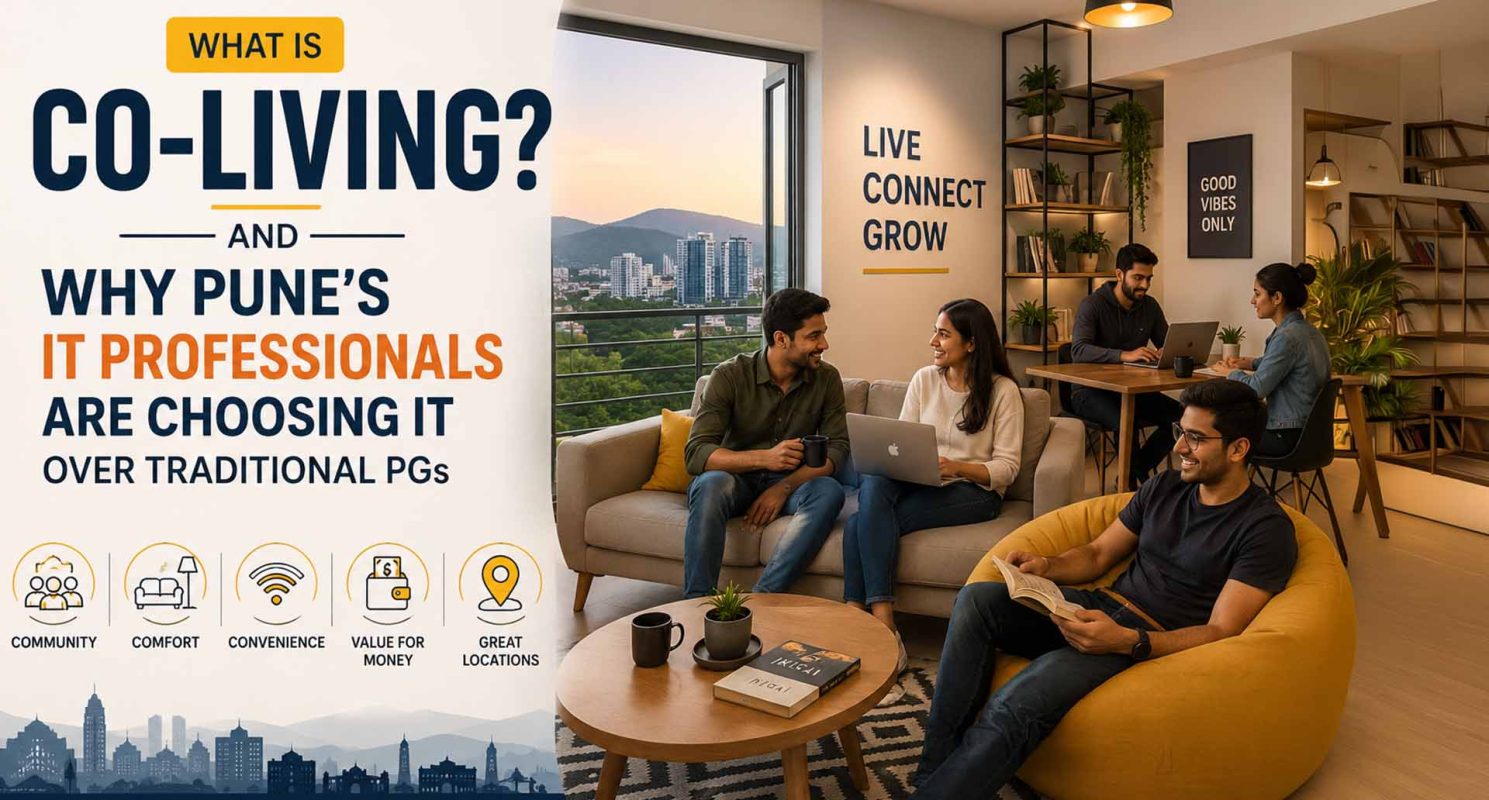
What is co-living? A housing model where residents live in private rooms within professionally managed spaces, with shared common areas and all-inclusive services — meals, Wi-Fi, housekeeping, and utilities — designed for convenience, flexibility, and community.
Co-living didn’t emerge as a trend; it emerged as a direct response to what wasn’t working:
- Expensive deposits and brokerage friction Traditional PG and flat rentals in Pune require two to three months’ deposit plus brokerage before a single night is spent. For professionals joining on their first or second paycheck, that upfront cash requirement is a genuine barrier.
- Poor and inconsistent PG experience “Fully furnished” in most PG listings means a bed and basic furniture. Wi-Fi drops during peak hours, meals are monotonous, housekeeping is irregular, and maintenance requests go unanswered. The gap between what’s advertised and what’s delivered is a consistent pattern.
- Lonely apartment living A 1BHK in Baner solves the quality problem but creates an isolation one. Professionals relocating to Pune solo no college network, no family nearby, find that independent living can be genuinely lonely, especially in the first six to twelve months.
- Hybrid work needs that standard accommodation doesn’t meet A bedroom doubling as an office doesn’t work when video calls need quiet, reliable internet, and a background that isn’t a wardrobe. Co-working infrastructure built into the living setup is now a practical need, not a nice-to-have.
- Rising rents making the PG-to-1BHK jump harder As Pune’s rental market has tightened, particularly near Hinjawadi Phase 3 and Wakad, the 1BHK route has become harder to justify on entry-level packages. Co-living’s all-inclusive model fits the gap between unlivable budget PGs and unaffordable independent flats.
What Does Co-Living Actually Include?
Co-living in Pune offers private bedrooms within professionally managed properties, with shared common areas like kitchens, lounges, and workspaces. The key difference from a traditional PG is that services aren’t an afterthought; they’re built into the model.
A standard co-living setup typically bundles:
- All-inclusive rent covering utilities, Wi-Fi, housekeeping, and meals → predictable monthly cost, no surprises
- Flexible lease terms (6–12 months) that suit Pune’s mobile IT workforce → no punitive lock-ins
- Zero brokerage and manageable security deposits → lower upfront barrier
- Dedicated co-working zones separate from bedrooms → ready-to-use working setup from day one
- Single operator managing everything → zero vendor coordination
Operators like Yukio Coliving in Hinjawadi Phase 3 and Wakad, and others in Viman Nagar, specifically target working professionals. The design reflects IT work realities: late-night deployments, weekend sprints, and the genuine need to separate workspace from rest space, even within a compact room.
How Co-Living Compares to Other Options
| Factor | PG | 1BHK | Co-living |
|---|---|---|---|
| Setup effort | Low | High | None |
| Privacy | Low | High | Medium |
| Cost predictability | Low | Medium | High |
| Community | Random | None | Built-in |
| Flexibility | Medium | Low | High |
| Upfront cost | Medium | Very high | Low |
| Amenities | Basic, inconsistent | Self-arranged | Comprehensive, managed |
Is Co-Living Actually Cheaper? The Real Cost Breakdown
The comparison isn’t just about the monthly rent; it’s about the total cost of
| Cost Head | Traditional PG | 1BHK Apartment | Co-Living |
|---|---|---|---|
| Monthly rent | ₹12,000–15,000 | ₹18,000–25,000 | ₹15,000–26,500 |
| Food | ₹8,000–10,000 | ₹6,000–8,000 | Included |
| Utilities/Wi-Fi | ₹1,500–2,000 | ₹2,500–3,500 | Included |
| Laundry | ₹1,000 | ₹2,000 | Included |
| Brokerage (upfront) | ₹10,000–15,000 | ₹18,000–25,000 | ₹0 |
| Deposit (upfront) | ₹15,000–30,000 | ₹36,000–75,000 | ₹10,000–20,000 |
| Monthly total | ₹22,500–28,000 | ₹28,500–38,500 | ₹15,000–26,500 |
The upfront cost difference is where co-living pulls ahead most clearly. A 1BHK in Wakad or Baner can demand ₹54,000–1,00,000 before you’ve spent a single night there. Co-living brings that down significantly and eliminates the broker entirely.
Beyond money, there’s the time and mental load of managing a household independently: coordinating with landlords, chasing broadband providers, and finding domestic help. Co-living folds all of that into one rent payment.
Yukio Tip: When comparing costs, always account for brokerage, deposit, and add-on expenses — not just the headline rent figure. The all-in monthly number tells the real story.
Location Makes All the Difference
Coliving Pune operators deliberately cluster properties near IT hubs, which directly affects commute time and daily quality of life.
- Hinjawadi Phase 3 and Wakad: Broadly 10–15 minutes from major IT campuses, including TCS, Infosys, and Wipro at Rajiv Gandhi Infotech Park, as well as Wakad’s growing tech corridor
- Viman Nagar: Close to EON IT Park and Phoenix Marketcity, well-suited for hybrid workers
- Baner: A midpoint between Hinjawadi and central Pune, with strong social infrastructure
Shorter commutes add up in meaningful ways. Time saved in transit is time available for the gym, networking, sleep, or simply decompressing after a demanding day, all things that affect long-term performance and wellbeing, not just convenience.
Yukio Tip: Before finalising any co-living property, check the actual commute during your office shift hours — not on a Sunday afternoon. Traffic patterns vary significantly by time of day.
The Community and Flexibility
This is where co-living in Pune addresses something traditional PGs and solo apartments both fall short on: the social dimension of relocating to a new city.
- For the community:
- Shared kitchens, lounges, and organised events create organic networking opportunities
- For professionals new to Pune, building a city network from scratch is genuinely hard. Co-living accelerates it
- 200+ residents per property means you’re surrounded by people on similar schedules and career stages
- For hybrid workers:
- Dedicated co-working zones, separate from bedrooms, quiet, reliable, purpose-built
- High-speed fibre with backup, not a shared router that drops during the 9 AM standup
- Desk and ergonomic setup as standard, not an afterthought
- For women professionals:
- Access-controlled entry keycard or biometric, not a gate that anyone can walk through
- CCTV coverage across all common zones
- On-site operations staff present at all hours
- Women-only floors with separate access control
- Verified, background-checked support staff
- For job switchers:
- Lease terms of 6–12 months aligned with IT market realities
- No 11-month lock-ins that trap residents mid-career move
- Exit terms that don’t penalise a role change or city transfer
Yukio Coliving: Co-Living Built for Pune’s IT Belt
Yukio Coliving operates in Hinjawadi Phase 3 and Wakad, both broadly 10–15 minutes from major IT campuses, with an all-inclusive model that covers meals, housekeeping, laundry, gym, co-working, power backup, and high-speed Wi-Fi.
Key details:
- Starting at ₹19,950/month (Hinjawadi Phase 3) and ₹26,500/month (Wakad)
- Zero brokerage, minimal security deposit
- 200+ residents per property — a professional community
- Transparent pricing with no surprise charges
For professionals who are currently eating out daily, spending on autos or cabs for longer commutes, and paying electricity and Wi-Fi add-ons separately, the real monthly outgo at a standard PG often lands in the same range anyway, with none of the reliability, community, or zero-brokerage upfront advantage.
Co-living bundles what you’re already spending into one predictable number, and removes the management overhead on top of it.
Ready to Rethink How You Live in Pune?
The traditional PG-or-1BHK binary made sense when those were the only options. Co-living in Pune has changed that — offering a model that’s financially competitive, locationally smart, and genuinely designed around how IT professionals actually live and work. If you’re relocating to Pune and want to skip the brokerage-deposit-broker cycle entirely, it’s worth a serious look.
Frequently Asked Questions
What is co-living, and how is it different from a PG?
Co-living offers private rooms in professionally managed communities with all-inclusive rent — Wi-Fi, housekeeping, utilities, meals, and amenities like gyms. Unlike traditional PGs, you get dedicated workspaces, flexible leases, and a structured community, with zero brokerage.
Which areas in Pune have the best coliving options for IT professionals?
Hinjawadi Phase 3, Wakad, Baner, and Viman Nagar are the strongest clusters. Hinjawadi Phase 3 and Wakad offer proximity to Rajiv Gandhi Infotech Park (TCS, Infosys, Wipro), while Viman Nagar sits close to EON IT Park.
What should I look for in a coliving space in Pune?
Prioritise internet quality, dedicated coworking spaces separate from bedrooms, proximity to your office (under 5-7 km ideal in Hinjawadi corridor), and transparent all-inclusive pricing with no hidden “maintenance” charges. Verify power backup, security features, and flexibility in lease terms. Visit during evening hours to gauge community vibe and actual noise levels.