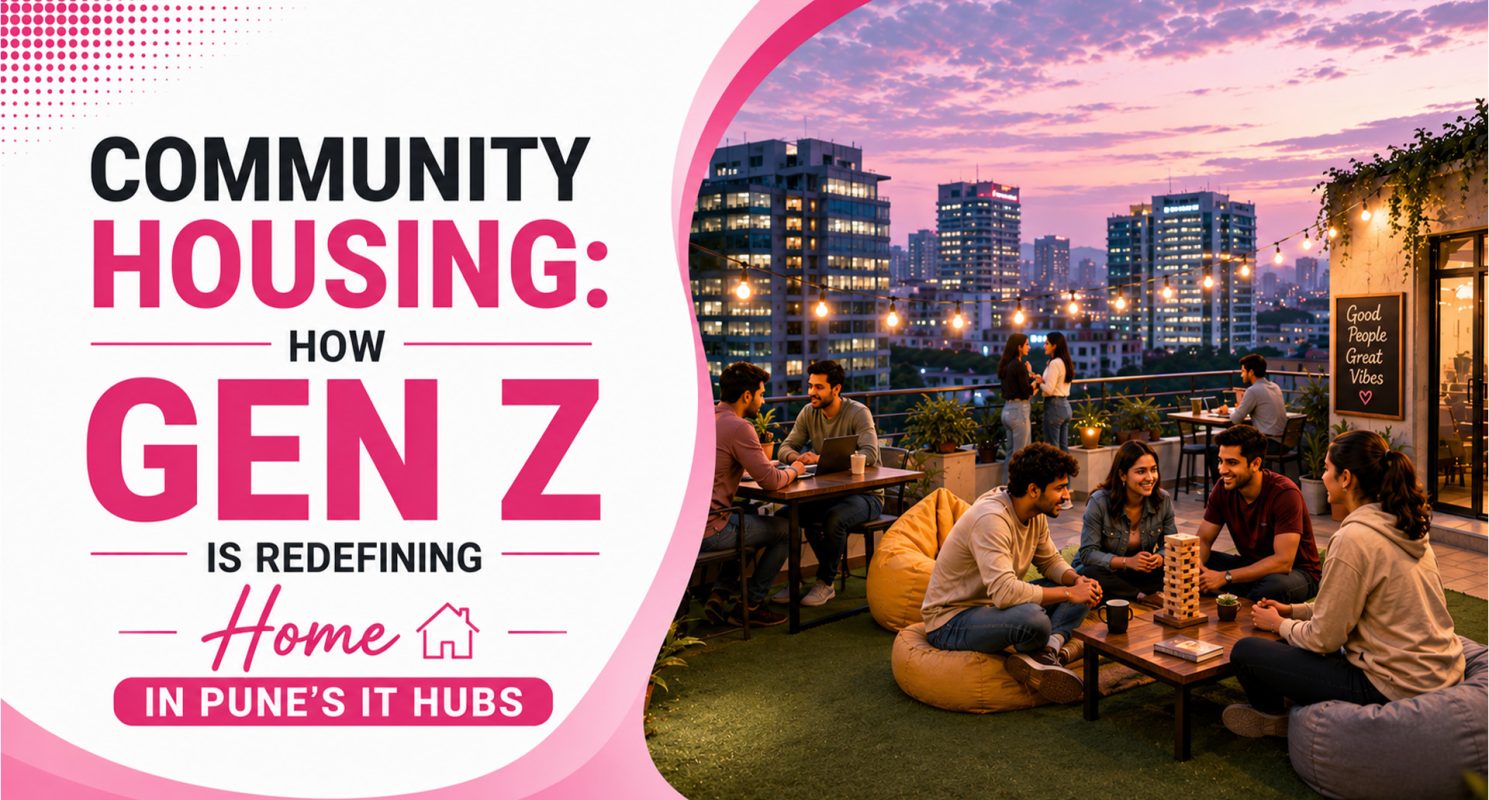
The traditional PG → 1BHK → EMI path isn’t the only option anymore — and a growing number of young IT professionals in Pune aren’t taking it. Community housing is gaining traction among Gen Z professionals who want flexibility, social connection, and logistics that don’t eat into their evenings. This guide breaks down what it actually is, why it’s resonating, and how Pune’s market is responding.
What Is Community Housing? (And Why It’s Not Just a Fancy PG)
Community housing refers to residential models that prioritise shared spaces, collective amenities, and intentional social connections alongside private living quarters. Co-working areas, communal lounges, fitness zones, event programming, not just a building where multiple tenants happen to share a wall.
| Feature | Traditional PG / Rental | Community Housing |
|---|---|---|
| Social infrastructure | Accidental — roommate lottery | Intentional — shared spaces, events |
| Amenities | Basic, inconsistently maintained | Comprehensive — co-working, gym, recreation |
| Lease flexibility | 11-month lock-in + deposits | Shorter commitments, flexible terms |
| Maintenance | Tenant-managed | Fully handled by the operator |
| Community | Isolation or luck | Built-in professional network |
| Pricing transparency | Hidden costs emerge over time | All-inclusive, predictable monthly outgo |
This isn’t about aesthetics. It’s about reducing the logistical and emotional overhead of setting up life in a new city — while building a support system at the same time.
Yukio Tip: Before comparing rents, add up your real monthly outgo — rent + food + electricity + Wi-Fi + laundry. That number is what you’re actually paying. Community housing pricing often looks different once you do the full calculation.
Signs You’re Looking for Community Housing (Even If You Don’t Realise It)
Sometimes the need is clear before the solution is. These are the signals worth paying attention to:
- You moved to Pune and spend most weekends alone
- Your PG feels transactional, not livable
- You want flexibility without feeling temporary
- You work remotely but don’t want the isolation that comes with it
- You value shared experiences more than extra square footage
If more than two of these feel familiar, a managed coliving setup is likely a better fit than a standard PG or independent flat.
Why Gen Z Is Choosing Community Over Ownership in Pune
The career math has changed, and housing preferences are following.
- The flexibility factor: When your next opportunity might require relocation in 60 days, a long lease and a furniture truck become liabilities. Community housing solves this with shorter commitments and plug-and-play convenience — move in with a laptop and a suitcase, move out without liquidating a household.
- The loneliness problem nobody discusses: Moving to Pune solo for work means weekends spent wondering if anyone wants to grab dinner or hit the gym. Community housing lowers the barriers to actual human connection — shared spaces and social programming create the conditions for it without forcing it.
- The affordability equation: Shared expense models spread the cost of utilities, internet, and maintenance across residents in ways that individual 1BHKs simply can’t match — especially once furniture, appliances, and unexpected repairs are factored in.
- The cultural shift is already visible: Across Pune’s IT corridor, professionals in their mid-twenties are choosing flexible coliving over rushed flat hunts and extending stays rather than committing to leases. Hybrid work making city mobility the norm has made flexibility a deliberate choice, not a temporary one.
Yukio Tip: If you’re relocating to Pune for your first role, resist the instinct to sign a long lease immediately. Give yourself 3–6 months in a flexible setup to understand the city, your commute, and your lifestyle needs — then decide.
Why Ownership Lost Its Emotional Advantage
For previous generations, buying a home carried meaning beyond the financial: stability, status, permanence. That equation has shifted for a 25-year-old in Pune’s IT sector.
What ownership can mean today:
- Debt lock-in: An EMI that outlasts enthusiasm for the city
- Wrong-city commitment: Purchased in Pune six months before a Bangalore offer arrives
- Reduced mobility: Every career opportunity weighed against the cost of leaving a flat behind
- Maintenance burden: Weekends managing plumbers and society fees instead of recovering
None of this means ownership is a bad decision. It means the timing has changed. For professionals still figuring out which city, company, and career trajectory fits them best, community housing keeps the future open.
Community Housing vs Other Options: A Decision Framework
| If you’re… | Best fit |
|---|---|
| New to Pune, want zero setup hassle | Managed community housing |
| Stable role, 2+ years planned, want privacy | 1BHK rental |
| On a tight budget, okay with basic living | Budget PG |
| Frequent traveler, hybrid role | Community housing with flexible terms |
| Building a social life in a new city | Community housing — intentional community matters |
Why Yukio Coliving Works for Pune’s Gen Z Professionals
The pain points that make standard PG living difficult — isolation, inflexibility, hidden costs, inconsistent maintenance — aren’t abstract. They’re the day-to-day reality of moving to a new city and figuring it all out alone.
Yukio Coliving addresses these directly across its properties in Hinjawadi Phase 3 and Wakad — both broadly 10–15 minutes from major IT campuses:
- Zero brokerage, transparent pricing: All-inclusive means no surprise maintenance bills, no utility negotiations, no broker fees. What you see is what you pay.
- Fully managed logistics: Furnished rooms, regular housekeeping, and scheduled laundry. Move in and start your job — not a second career managing a household.
- Built-in community: Co-working spaces, recreation zones, and communal areas designed for professionals who understand deadlines and career mobility.
- Location that works: Direct access to the Hinjawadi IT corridor, with metro connectivity supporting commutes across Pune.
- Flexibility for what comes next: When your role, team, or city changes, you’re not fighting a landlord over deposits or finding buyers for a sofa.
The Smarter Starting Point
Community housing in Pune isn’t a trend waiting to peak — it’s a rational response to how modern careers and urban life actually work for this generation. Flexible, fully managed, socially connected living isn’t a compromise on the way to something better. For many Gen Z professionals in Pune’s IT sector, it’s simply the best option available right now.
Frequently Asked Questions
What is community housing, and how does it differ from regular rentals?
Community housing combines private living quarters with shared amenities — co-working spaces, fitness facilities, communal lounges — managed by a professional operator. Unlike standard rentals, where you handle everything independently, community housing covers maintenance, builds social infrastructure, and typically offers more flexible lease terms, all at one transparent price.
Why is Gen Z choosing co-living over buying homes in Pune?
Frequent job changes and career mobility make long-term property commitments a poor fit for many young professionals. Co-living provides the lifestyle amenities Gen Z values — community, convenience, flexibility — without locking them into decisions that don’t align with where their careers are right now. Ownership isn’t off the table; it’s simply deferred until the timing makes more sense.
Which Pune neighborhoods are best for community housing?
For IT professionals, the Hinjawadi Phase 3 and Wakad corridor is the most practical base — both areas offer direct access to major IT campuses, metro connectivity, and strong neighborhood infrastructure. Other parts of Pune, like Baner and Koregaon Park, have lifestyle appeal but may involve longer commutes to the core IT parks, depending on your workplace.