
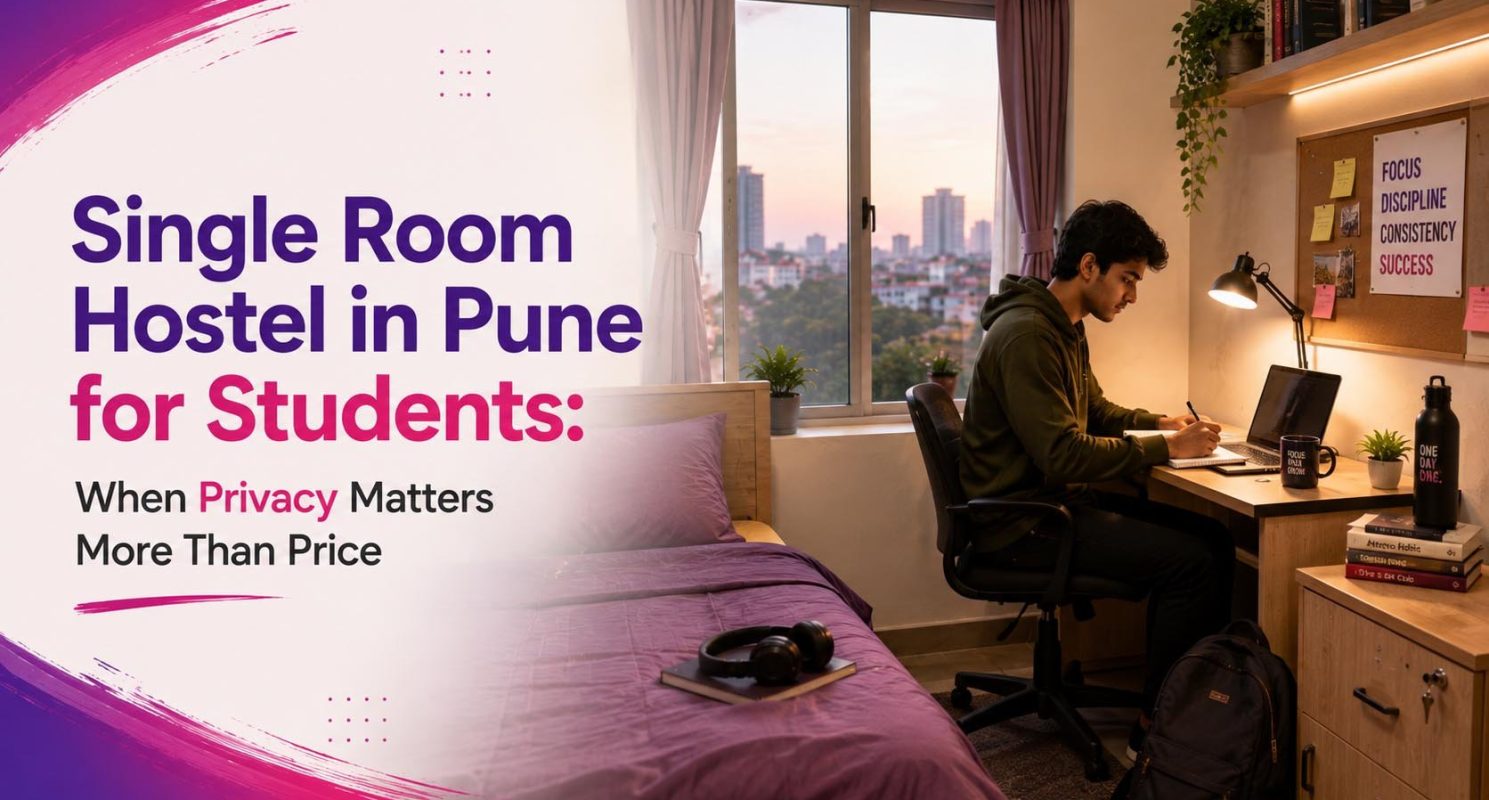
That ₹8,000/month single room in Hinjawadi Phase 3 looks great on paper until you add one to two months’ security deposit, one month’s brokerage, ₹3,000–₹5,000/month in meals because food isn’t included, and an electricity meter that runs higher than expected. Suddenly, that ₹8,000 room is actually costing ₹12,000–₹16,000 every month.
For students hunting for a single room hostel in Pune for students, the price tag is just the opening line of a much longer story. This guide breaks down what single occupancy actually costs, where the value lies, and how to avoid the hidden traps that catch first-timers every admission season.
What Does a Single Room Hostel in Pune for Students Actually Cost?
The real answer depends heavily on the neighborhood and what’s bundled in.
| Area | Single Room Cost | Best For |
|---|---|---|
| Kothrud | ₹7,000–₹10,000/month | MIT-WPU, SPPU students |
| Viman Nagar | ₹7,000–₹10,000/month | Symbiosis students |
| Wakad | ₹10,000–₹14,000/month | Metro-connected students |
| Hinjawadi Phase 3 | ₹10,000–₹14,000/month | Internship-heavy students |
| Baner | ₹15,000–₹20,000/month | Premium housing seekers |
Compare this to double sharing at ₹7,000–₹10,000/month or triple sharing at ₹7,000–₹8,000/month. The single room premium runs ₹5,000–₹8,000 extra. Whether that’s worth it depends on what you value more: your wallet or your sanity during exam week.
Yukio Tip: Kothrud and Viman Nagar offer the best price-to-privacy ratio for students single rooms at ₹7,000–₹10,000/month with good connectivity to major colleges. Factor in commute costs to your specific institution before assuming the lower rent is a saving.
Why Privacy Is an Academic Necessity, Not a Luxury
Here’s what the brochures don’t tell you about shared rooms: your roommate’s 2 AM phone calls, an alarm that goes off four times before they wake up, a “quick study break” that becomes three hours of gaming. Single rooms eliminate conflicts over study schedules, sleep patterns, and visitor policies.
When you’re preparing for MBBS finals or finishing an MBA case study at midnight, having control over your environment isn’t pampering yourself; it’s protecting your GPA.
The practical benefits stack up:
- Video calls with family without coordinating roommate schedules
- Online classes and vivas without background noise
- Study sessions that don’t depend on someone else’s Netflix preferences
- Sleep schedule aligned to your body, not your roommate’s social life
That said, privacy has trade-offs worth acknowledging.
Some students, particularly those moving to Pune for the first time, find shared rooms genuinely useful in the early months. A roommate provides built-in social contact, local guidance for navigating a new city, and an easier adjustment to independent living.
The right choice depends on where you are in your student journey: first-year students settling into a new city often benefit from shared living, while those in placement season, final-year projects, or internship-heavy semesters tend to find uninterrupted focus more valuable than company.
When Students Usually Start Wanting a Single Room
Many students happily share accommodation in their first year. The preference for single occupancy typically shifts later, and for specific reasons.
Placement preparation changes schedules unpredictably. Mock interviews, company research sessions, and late-night application deadlines don’t align neatly with a roommate’s routine. Final-year projects involve long, irregular working hours that make shared sleep schedules difficult to manage. Competitive exam preparation, whether for CAT, GATE, or UPSC, alongside a degree requires consistent quiet that shared rooms rarely provide. Internship-heavy semesters add early starts and variable return times to the mix.
The pattern is consistent: students who were content sharing in year one often reassess by year two or three, once the social adjustment is settled and academic pressure intensifies. If you’re evaluating accommodation options ahead of these semesters, factoring in the single room premium now is worth the planning.
The Hidden Costs That Turn “Cheap” Into Expensive
A listing showing ₹8,000/month rarely means you’ll pay ₹8,000/month.
- The deposit trap: Most single-room accommodations require one to two months’ rent as a security deposit. For a ₹12,000 room, that’s ₹12,000–₹24,000 locked away before you’ve unpacked. Some landlords return only a portion at exit, citing damages that weren’t documented at move-in.
- The brokerage bite: Many agents charge one month’s rent to show you listings. Zero-brokerage options exist; look specifically for direct-owner listings, but you need to know how to filter for them.
- The meal math: “Food Not Available” on a listing means ₹3,000–₹5,000/month extra for cooking or eating out. That ₹8,000 room is now ₹11,000–₹13,000.
- The commute calculation: A cheap PG far from campus can add ₹3,000–₹4,000/month in transport costs plus significant daily travel time. Spending slightly more on a better-located accommodation often saves money overall and avoids mid-semester relocations.
Yukio Tip: Before signing, add up deposit, brokerage, food, electricity, and commute alongside the monthly rent. The true monthly cost is what matters — not the headline figure on the listing.
What Premium Features Actually Justify Higher Rent?
Not every expensive listing is overpriced. Some features genuinely matter.
Attached bathrooms add ₹1,000–₹3,000/month but eliminate the morning rush and shared bathroom friction. For women, especially, a private bathroom significantly affects comfort and security.
AC adds ₹1,500–₹4,000/month and becomes non-negotiable during Pune’s summer months when you’re trying to focus on exam preparation.
Security features — CCTV, biometric access, trained staff add ₹500–₹1,500/month. Parents paying the rent tend to consider this money well spent.
Yukio’s Take
The real question isn’t “single room or shared?” It’s “what’s the true all-in cost, and what am I getting for it?” A ₹10,000 room that requires a ₹20,000 deposit, ₹10,000 brokerage, ₹4,000 food, and ₹2,000 electricity every month isn’t cheaper than a ₹20,000 all-inclusive option. It’s just hiding its costs better. Compare actual monthly spend, not listing prices.
When All-Inclusive Makes the Math Work
For students who want to stop running spreadsheets on hidden costs, professionally managed coliving is worth comparing directly.
Yukio Gates in Wakad and Yukio Jobs in Hinjawadi Phase 3 offer all-inclusive pricing of ₹26,500/month (Wakad) and ₹19,950/month (Hinjawadi Phase 3), covering three meals daily, housekeeping, laundry, high-speed Wi-Fi, gym access, and utilities. One predictable monthly number, nothing hidden.
Students planning ahead can reduce costs further: an 11-month tenure plan offers up to 11% off the monthly rate, with an additional 3–4% off for upfront payment.
Dedicated student floors 6th, 7th, and 8th floors at Yukio Gates for female students; 17th floor at Yukio Jobs for all students create a peer network before orientation even begins. Women-only floors come with all-women on-site staff, biometric entry, and 24/7 CCTV. For parents writing the checks, the transparent pricing and professional management address the “what’s actually happening there” question directly.
Book a tour at yukio.in, compare what’s included against any other listing you’re considering.
Privacy Is a Productivity Decision
Choosing a single room hostel in Pune for students isn’t about being antisocial. It’s about controlling your environment during the most academically demanding years of your life. Whether you choose a ₹7,000 single room in Kothrud or a premium all-inclusive setup, run the numbers honestly — deposit, brokerage, food, electricity, commute. The cheapest listing is rarely the cheapest life once everything is counted.
Frequently Asked Questions
How much should I budget monthly for a single room in Pune as a student?
Plan for ₹18,000–₹28,000/month all-in, covering accommodation, food if not included, transport, and daily expenses. All-inclusive coliving simplifies this to one fixed number with no variable add-ons.
Are single rooms in Pune PGs safe for female students?
Quality varies significantly. Look for properties with CCTV in common areas, biometric or keycard entry, and trained on-site staff. Dedicated women’s floors with all-women staff provide the strongest safety layer and give parents a concrete checklist to verify.
What hidden costs should parents watch for in single-room PG listings?
The main gaps: deposit terms (one to two months’ rent — get refund conditions in writing), brokerage fees, meal costs if excluded, and electricity charges. Get the full monthly breakdown in writing before any payment changes hands.