
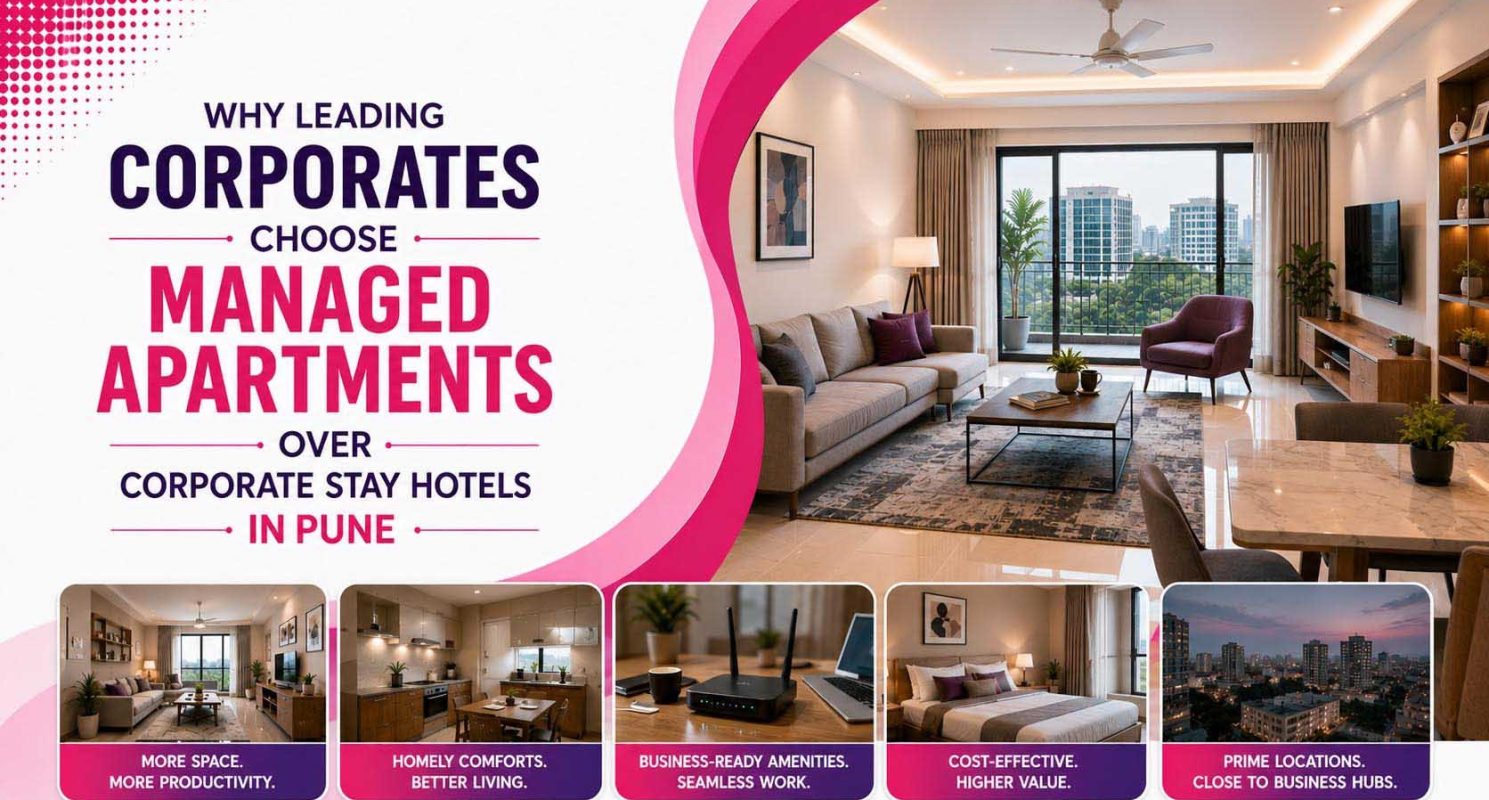
That Infosys relocation package looks great until the math hits. Your HR team books you into a corporate stay hotel in Pune at approx. ₹2,500/night, expecting a two-week stay. Three months later, you’re still there—and the company’s accommodation budget just blew past ₹70,000/month. No wonder leading corporates in Pune’s Hinjawadi and Baner tech hubs are rethinking their employee housing strategy.
This breakdown compares corporate stay hotels versus corporate managed apartments in Pune on the metrics that actually matter: total cost, flexibility for 3–6 month relocations, and what keeps mid-level IT professionals from jumping ship within their first year. If you’re relocating employees to Pune’s IT belt or planning your own move, here’s what the numbers really show.
The Real Cost of Corporate Stay Hotels in Pune
A typical corporate stay hotel charges somewhere around ₹2,000–2,500/night for a deluxe AC room with WiFi and parking. Add taxes, and that’s around ₹75,000–84,000 for a 30-day month.
Here’s what you actually get for that ₹75k+:
Included amenities:
- AC room
- WiFi
- Parking
- Continental breakfast (basic)
Not included:
- Lunch/dinner (nearby meals run ₹200–400; expect ₹8,000–12,000/month based on Pune averages)
- Consistent housekeeping beyond basic daily service
- Laundry (outsourced, variable pricing)
The catch most corporates discover around month two: these corporate stay hotels excel at short business trips (1–7 days) but weren’t designed for the 3–6 month probationary period that Hinjawadi’s TCS, Infosys, and Wipro commonly use for new hires.
No community spaces. No meal consistency. And at ₹80,000+ monthly, the ROI for employee retention starts looking questionable fast.
When Temporary Accommodation Stops Feeling Temporary
Hotels work exceptionally well for travel.
But long-duration relocations create very different needs:
- routine stability
- predictable food habits
- familiarity after work
- lower decision fatigue
- spaces that feel livable instead of transactional
That’s often where managed living starts outperforming traditional business hotels—even though both technically solve “accommodation.”
For a 3–6 month relocation, employees usually aren’t looking for a place to stay—they’re looking for a place they can settle into while adjusting to a new team, commute, and city.
That shift matters more than most companies expect.
A hotel room may feel convenient in week one.
By month three, the same setup can feel repetitive, isolating, and disconnected from day-to-day routines.
Managed apartments bridge that gap by offering practical stability without the complexity of renting a traditional flat.
Why Corporate Managed Apartments Make Financial Sense
Managed apartments in Baner and Hinjawadi typically run ₹15,000–30,000/month for single occupancy with meals included.
Premium options in the ₹19,950–30,000 range (like Yukio-tier properties) generally include:
- Furnished private rooms
- Three meals daily
- WiFi
- Housekeeping
- Laundry
- Gym access
- Co-working spaces
- Zero brokerage (vs. 1-2 months for traditional apartments)
- Manageable deposits
The corporate math that actually matters
| Accommodation Type | Monthly Cost | 6-Month Total | Includes Meals? |
|---|---|---|---|
| Corporate Stay Hotel | ₹75,000–84,000 | ₹4.5L–5L | No |
| Premium Managed Apartment | ₹19,950–30,000 | ₹1.2L–1.8L | Yes |
| Savings | 60–75% | ₹2.7L–3.3L | — |
That ₹3 lakh difference over six months matters.
For corporates relocating 20–50 employees annually into Hinjawadi Phase 1 or Baner IT Park, managed apartments aren’t just more affordable—they create more predictable housing costs while improving the employee experience during onboarding.
The Flexibility Factor: What Long-Term Employees Actually Need
Here’s the pattern many Pune-based companies have started following: hotels for the first few days or weeks, then a transition into managed apartments for probationary or project-based stays.
The reason isn’t just cost.
It’s what happens to employee satisfaction when someone is living out of a hotel room after a 10-hour shift with no real routine beyond work.
What Companies Often Underestimate During Relocation
- Onboarding fatigue
- Commute unpredictability
- Isolation after work hours
- Hidden living expenses beyond hotel bills
- Employee burnout during setup phases
- Retention impact of unstable routines
These are easy to overlook because they don’t show up clearly on accommodation invoices.
But they shape the relocation experience in ways that affect productivity and retention.
Managed apartments solve several of these challenges more naturally than hotels:
Predictable commute proximity
Properties in Hinjawadi Phase 1 or Baner place employees close to major offices—often 6–8 km away.
That typically means manageable commute windows without forcing teams to spend hotel-level budgets.
Community for young professionals
For employees in the 22–34 age bracket, relocation can feel isolating fast.
Managed apartments with shared lounges, co-working areas, and resident communities create built-in social infrastructure that hotels rarely offer.
That matters for morale—especially during the first few months.
Lower setup friction
Traditional rentals often involve brokerage, furniture, utility setup, and paperwork.
Hotels avoid that but become expensive quickly.
Managed apartments offer move-in readiness with simpler terms.
Flexible exits
For project timelines that shift, managed apartments provide a practical middle ground: easier than traditional rentals, more sustainable than hotel billing.
Yukio’s Take
The hotel vs. managed apartment conversation isn’t only about saving ₹50,000+ per employee each month.
It’s about what companies learn over time:
Short-term convenience doesn’t always support long-term relocation success.
Employees adjusting to Pune already have enough on their plate—new teams, unfamiliar routes, different routines.
Housing that feels practical, stable, and easy to settle into reduces friction during that transition.
And when accommodation feels manageable financially and mentally, retention usually benefits too.
Pune’s IT sector continues to expand rapidly, with professionals moving into Hinjawadi and Baner throughout the year.
The companies making relocation easier aren’t necessarily booking the most premium hotels.
They’re choosing setups that balance budget, flexibility, and day-to-day livability.
Where Smart Corporates Are Housing Employees Now
This is where the housing strategy has clearly shifted.
Managed living providers like Yukio Coliving in Hinjawadi and Baner position themselves close to major IT campuses while offering all-inclusive services at ₹19,950–26,500/month.
For corporates, that typically means:
- 60%+ cost savings vs. corporate hotel stays
- Zero brokerage fees
- Faster move-ins after offer acceptance
- Built-in community infrastructure
- Predictable budgeting with fewer surprise expenses
For employees earning ₹8–15 LPA in Pune’s IT corridor, it often feels simpler:
Live close to work.
Pay one all-inclusive amount.
Spend less time managing logistics and more time settling into work and city life.
The corporate housing conversation in Pune has evolved beyond “hotels vs. apartments.”
It’s now about the total relocation experience—financially and practically.
And for longer-duration moves, managed apartments are increasingly filling a gap hotels were never designed to solve.
Frequently Asked Questions
Why are corporates switching from hotels to managed apartments in Pune?
Cost savings often start the conversation.
But the bigger advantage is predictability: easier budgeting, less setup friction, stronger community, and a better fit for relocations that stretch across several months.
What’s included in corporate managed apartments in Hinjawadi?
Premium managed apartments in Hinjawadi and Baner usually include furnished private rooms, meals, WiFi, housekeeping, laundry, gym access, and co-working spaces.
They’re designed to be move-in ready without the complexity of a traditional rental.
Which Pune neighborhoods work best for IT professionals on corporate relocations?
Hinjawadi and Baner remain top choices.
Both offer access to major IT campuses while balancing commute convenience and lifestyle infrastructure.
Managed apartments here often help employees stay connected to work without taking on the stress of full rental setup.