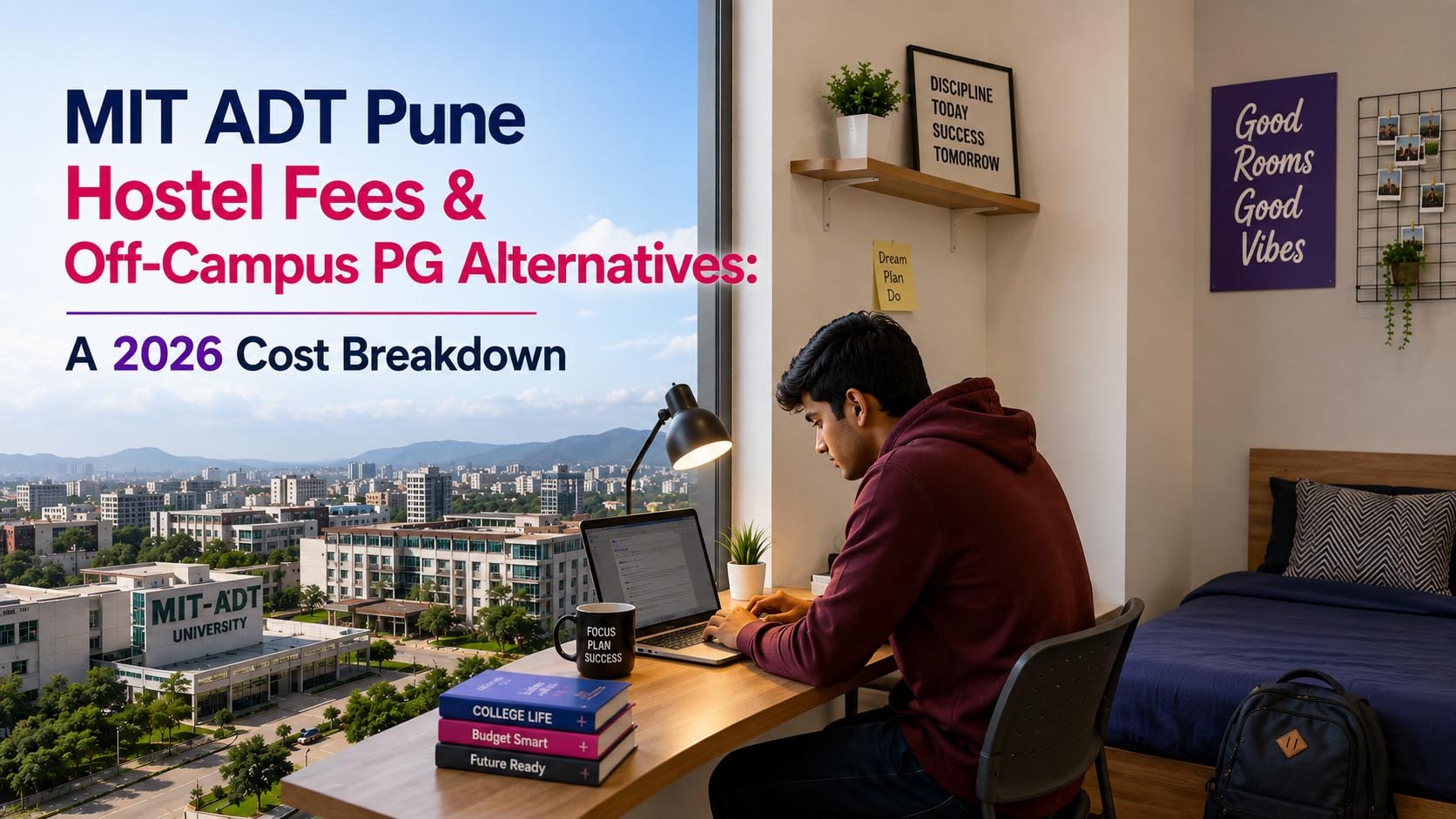
The advertised figure for MIT ADT’s double-sharing accommodation is ₹2,15,000/year. But that’s before transport charges for off-campus placements kick in, adding approximately ₹25,000 per semester. Suddenly, the annual outlay hits ₹2,65,000. Meanwhile, off-campus PGs in Loni Kalbhor start at ₹5,000–₹10,000/month for triple sharing. The math isn’t complicated; it’s just rarely done upfront.
This breakdown covers actual MIT ADT Pune hostel fees, off-campus PG alternatives near the Loni Kalbhor campus, hidden costs that catch families off guard, and how to evaluate value beyond the sticker price. Whether the budget conversation happens with parents or a spreadsheet, the numbers here will help.
Accommodation Isn’t Just About Cost
Most MIT ADT students don’t need the cheapest accommodation option. They need the option that supports how they’ll actually live, study, create, and manage their workload over the next four years. A room that looks affordable on paper can become expensive if it creates daily friction through poor food, unreliable internet, long commutes, limited study space, or constant logistical hassles.
The better question isn’t “What’s the lowest monthly rent?” It’s:
“Which accommodation setup helps me perform best academically while staying within budget?”
That shift in thinking often changes the entire decision.
What Do MIT ADT Hostel Charges Actually Include?
MIT ADT University operates one boys’ accommodation and seven girls’ accommodations (five on-campus, three off-campus), serving its 8,400+ students across the 125-acre Loni Kalbhor campus. The MIT ADT hostel charges break down as follows:
| Occupancy Type | Annual Fee | What’s Included |
|---|---|---|
| Triple sharing | ₹1,85,000 | Wi-Fi, 24/7 electricity, hot water, daily cleaning |
| Double sharing | ₹2,15,000 | Above + attached bathroom, study table, cupboard |
| Male students | ₹1,65,000 | Same facilities as above |
The campus provides four meals daily with weekly rotating menus, though food quality receives mixed reviews. Many students end up supplementing with tiffin services (₹2,500–₹4,000/month), which chips away at the “all-inclusive” value proposition.
Yukio’s Tip: When comparing accommodation costs, add ₹3,000–₹4,000/month to any option without included meals. That’s the real cost of eating outside, and it’s often invisible until the first month’s bills arrive.
How Does MIT ADT Loni Kalbhor Accommodation Compare to Off-Campus PGs?
The Loni Kalbhor PG market caters heavily to MIT ADT students, with options ranging from basic to premium:
| Occupancy | Monthly Rent | Annual Cost |
|---|---|---|
| Triple sharing (basic) | ₹5,000–₹10,000 | ₹60,000–₹1,20,000 |
| Double sharing | ₹6,000–₹12,000 | ₹72,000–₹1,44,000 |
| Single occupancy | ₹8,000–₹15,000 | ₹96,000–₹1,80,000 |
| Premium (AC + food) | ₹12,000–₹18,000 | ₹1,44,000–₹2,16,000 |
The savings look attractive until you factor in unbundled costs. Off-campus students typically pay ₹700–₹1,600/month for transport and ₹900–₹2,200/month for utilities when Wi-Fi and power aren’t included. Add ₹3,200–₹6,200/month for meals if food isn’t bundled.
The deposit situation is friendlier than in metro Pune. Most Loni Kalbhor PGs charge one month’s rent as a deposit, compared to the 2–3 months typical elsewhere. Platforms like NoBroker and UrbanPune help students find direct owner contacts, eliminating brokerage entirely.
What Are the Hidden Costs in MIT ADT University Fees for Accommodation?
The MIT ADT outstation hostel cost includes a transport surcharge that catches many families off guard. Students placed in off-campus hostels pay approximately ₹25,000 per semester for shuttle services. That’s ₹50,000/year on top of the advertised accommodation fee.
Breaking down the actual monthly cost comparison:
| Expense | MIT ADT Accommodation (Double) | Off-Campus PG (Double, With Meals) |
|---|---|---|
| Base rent + meals | ₹17,917/month | ₹10,000–₹14,000/month |
| Transport | ₹0 (on-campus) or ₹4,167 (off-campus) | ₹700–₹1,600/month |
| Utilities | Included | ₹900–₹2,200/month (if unbundled) |
| Total Monthly | ₹17,917–₹22,084 | ₹11,600–₹17,800 |
The real savings for off-campus PGs range from ₹1,400 to ₹75,800 annually for double sharing, and ₹65,000 to ₹1,25,000 for triple sharing. But savings alone don’t tell the whole story.
Yukio’s Take
The accommodation decision for MIT ADT students isn’t purely financial. On-campus placement guarantees proximity and structured living; off-campus PGs offer flexibility and potential savings. But both options leave students managing multiple variables: food quality, transport logistics, utility payments, and the unpredictability of unorganized accommodation. The question isn’t just “what costs less?” but “what includes everything without the spreadsheet gymnastics?”
What Should Parents Know About Safety and Quality?
For female students especially, the security infrastructure matters. Girls’ accommodations and PGs in Loni Kalbhor typically advertise CCTV surveillance, security guards, and biometric access, but the actual quality varies significantly from property to property.
Rather than relying on brochures, parents should ask specific questions during visits:
- Is there a curfew or entry restriction policy?
- Is transport available after dark if students stay late on campus?
- How far is the accommodation from the campus gate?
- Are wardens or supervisors available on-site?
- What emergency support exists during medical or security situations?
- Is power backup available during outages?
- How are visitors managed and recorded?
These practical questions often reveal more about day-to-day student safety than marketing claims. MIT ADT’s on-campus accommodation provides standardized security processes and university oversight, which many parents find reassuring. Off-campus options can offer excellent environments as well, but require individual verification before committing.
Accommodation Needs Differ Across MIT ADT Programs
One mistake families make is assuming every student needs the same accommodation setup. Different programs create very different daily routines.
| Program Type | Typical Accommodation Priority |
|---|---|
| Design Students | Late-night studio access, collaborative spaces, flexible schedules |
| Architecture Students | Project workspace, storage, and long working hours |
| Engineering Students | Predictable routines, budget efficiency, and reliable internet |
| Fine Arts Students | Creative flexibility, storage for materials, spacious rooms |
| Management Students | Networking opportunities, professional study environments |
A design student returning from a studio project at midnight has different needs than an engineering student following a structured timetable. Similarly, architecture students often prioritize workspace and storage, while management students may value community spaces and professional networking opportunities.
The smartest accommodation choice isn’t necessarily the cheapest or the closest. It’s the one that aligns with the demands of your specific course and lifestyle.
The Smarter Way to Evaluate Your Options
The MIT ADT accommodation decision ultimately depends on priorities: campus proximity, cost optimization, lifestyle quality, or some combination. On-campus options provide convenience; local PGs offer savings; premium coliving delivers professional management and community.
Whatever the choice, the numbers should be calculated honestly, with hidden costs included, not discovered three months into the academic year.
See the difference firsthand
For students exploring premium coliving as an alternative or supplement to campus accommodation, Yukio Gates offers property tours with no obligation. Visit yukio.in to schedule a visit and experience what all-inclusive actually means.
Frequently Asked Questions
What is the total cost of MIT ADT accommodation including all charges?
Double-sharing accommodation costs ₹2,15,000/year, but students placed in off-campus hostels pay an additional ₹50,000 annually for transport. Including potential supplementary food costs of ₹30,000–₹48,000/year, the actual annual outlay can reach ₹2,65,000–₹3,13,000.
Are off-campus PGs near MIT ADT safe for female students?
Most Loni Kalbhor PGs offer 24/7 security guards, CCTV surveillance, and biometric entry systems. However, quality varies significantly. Parents should verify facilities through in-person visits during evening hours when actual conditions become visible.
How much can students save by choosing an off-campus PG over MIT ADT accommodation?
Depending on sharing preference and amenity choices, annual savings range from ₹1,400 to ₹1,25,000. Triple-sharing PGs offer the highest savings (₹65,000–₹1,25,000/year), while premium PGs with AC and food may cost more than on-campus options.