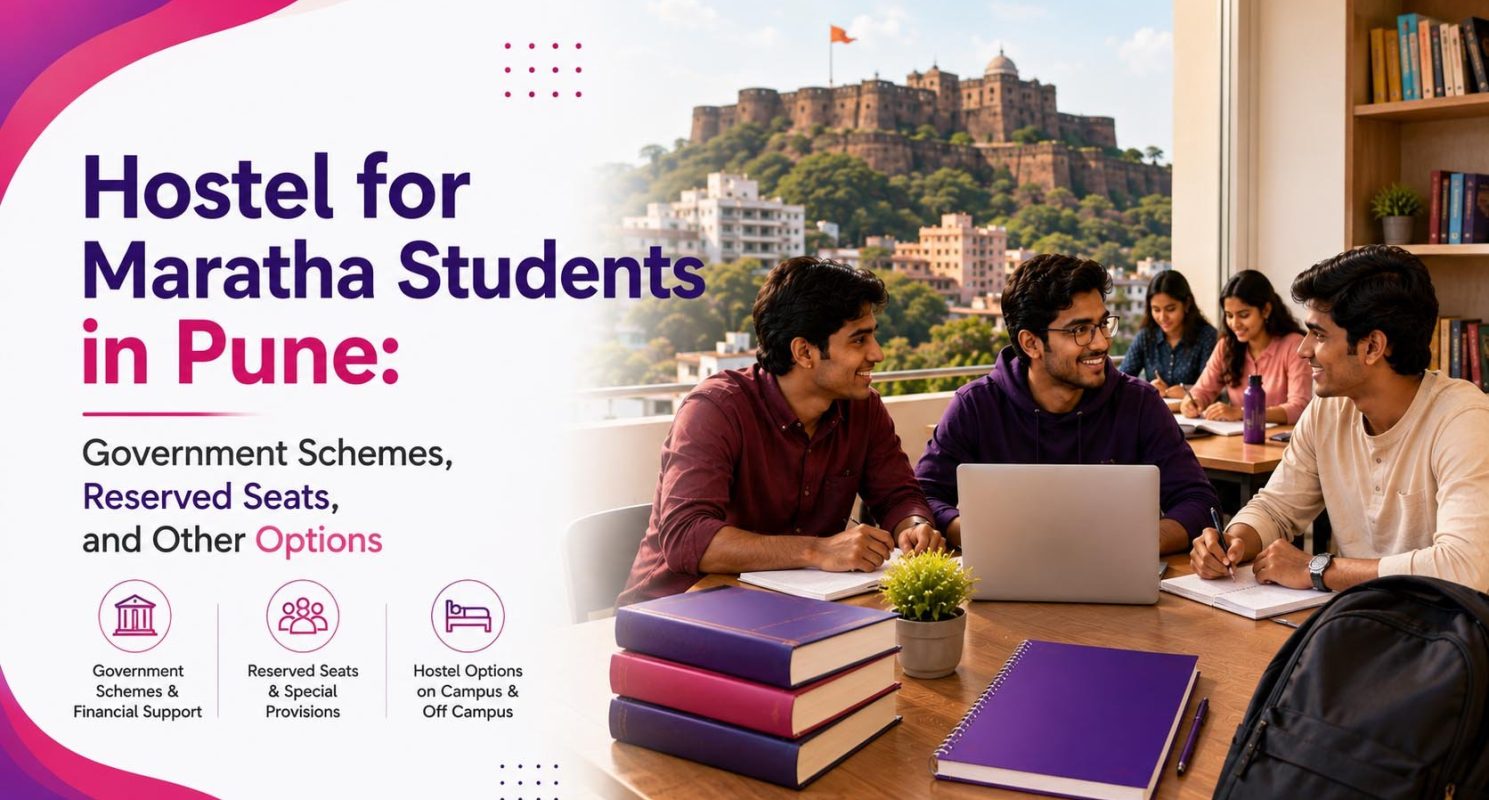
Maharashtra’s 10% Maratha reservation in education sounds like a win on paper. But here’s what nobody tells you upfront: the reservation gets you a college seat, not a bed. Hostel for Maratha students in Pune runs on a completely separate track — with income caps at ₹2.50 lakhs, merit-based selection, and seats that fill fast. Most students who apply don’t get in.
This guide covers every option — government schemes, reserved seats, and private alternatives — so you’re not caught planning accommodation as an afterthought.
What Government Schemes Actually Offer Maratha Students
The state runs two primary support systems worth knowing about.
The first is the government hostel scheme under the Social Justice Department, which provides free accommodation including meals, bedding, and basic supplies. The catch: your family income must be under ₹2.50 lakhs annually, and seats are limited.
The second is the Dr. Panjabrao Deshmukh Hostel Maintenance Allowance, available through MahaDBT. If your parents are marginal landholders or registered laborers, you can receive ₹30,000/year in Pune for 10 months. For general EWS students with family income below ₹8 lakhs, the allowance drops to ₹3,000/year — roughly ₹250/month.
Key eligibility criteria for government hostels:
- Maharashtra residency required
- Applications open from 8th grade onwards
- Merit-based selection after income verification
- Maximum 5 hostel preferences allowed per district
The Challenge Is Often Not Eligibility — It’s Capacity
Many students qualify on paper but still face accommodation uncertainty because available seats are significantly lower than demand. Qualifying for a scheme and securing a seat are two different outcomes. This is why most students need a parallel accommodation plan in place, even while their government applications are being processed — treating a hostel allotment as a given is the most common planning mistake families make.
Yukio Tip: Apply through the HMAS portal (hmas.mahait.org) the moment admissions open. Government hostel seats fill on a first-come, first-served basis after merit screening — waiting even a week can mean missing out entirely.
How Do Reserved Seats Work for a Hostel for Maratha Students in Pune?
Traditional government hostels under the Social Justice Department primarily reserve seats for SC/ST/VJNT/OBC categories. Maratha students fall under the separate EWS framework, which operates a parallel 10% quota.
The state also runs Matoshri Hostels specifically for Economically Weaker Section students, including Marathas who don’t qualify for other reserved categories. SARTHI (Chhatrapati Shahu Maharaj Research, Training and Human Development Institute) supports Maratha students through skill development programs and dedicated hostels like the Matoshri Girls Hostel.
Application process:
- Register on the Maharashtra Aaple Sarkar DBT Portal
- Apply for both EWS seats and general hostel allotments
- Contact Pune Social Welfare Headquarters at 020-26127569 for application status
- Email sakalyangovthostel@gmail.com for grievance resolution
What Happens If You Don’t Get a Hostel Seat?
Every year, many eligible students apply for government accommodation and don’t secure a seat — not because they failed to qualify, but because demand consistently exceeds capacity. This is the reality families aren’t warned about early enough.
When a hostel allotment doesn’t come through, the options families typically evaluate are: community hostels (operated by trusts in areas like Sadashiv Peth and Navi Peth, availability unpredictable), private PGs (abundant but inconsistent on safety, hygiene, and included costs), shared flats (flexibility without management or security), and managed student housing (professionally run, all-inclusive, predictable).
The decision isn’t just about cost. For students from outside Pune — enrolled at DY Patil, NICMAR, Symbiosis, Shri Balaji, or Indira — the question is which option gives parents enough confidence and students enough stability to focus on academics from day one.
Yukio Tip: Don’t wait for a rejection letter to start shortlisting alternatives. Begin evaluating backup options the moment you submit your government hostel application — the best private alternatives fill up quickly too.
Your Accommodation Action Plan: Stage by Stage
| Stage | What To Do |
|---|---|
| Admission secured | Apply for government hostel immediately via hmas.mahait.org |
| Scholarship applications open | Apply for DBT allowances through MahaDBT portal |
| Waiting for allotment | Shortlist 2–3 private backup options; visit in person |
| Hostel rejected | Evaluate managed coliving and community trust hostels |
| Private option chosen | Confirm all-inclusive pricing, safety, and lease terms |
What Does ₹6,000 Actually Get You in a Private PG?
When government options don’t work out, most students turn to private PGs in Kothrud, Karve Nagar, Katraj, or Shivaji Nagar. Here’s the real cost breakdown:
| Accommodation Type | Monthly Cost | What’s Included | What’s Extra |
|---|---|---|---|
| Shared PG (3–4 sharing) | ₹6,000–₹12,000 | Basic room, sometimes Wi-Fi | Electricity (₹800–₹2,500), laundry |
| Single PG room | ₹12,000–₹20,000 | Private room, meals vary | Same hidden costs |
| College hostel | ₹4,000–₹10,000/year | Basic accommodation | Limited seats, merit-based |
The “inclusive” pricing many PGs advertise often excludes electricity, which adds ₹800–₹2,500/month depending on AC or geyser usage. Most PGs also require one to two months’ rent as a deposit plus one month’s brokerage — costs that rarely feature in the initial quote.
Yukio’s Take
The math doesn’t lie: government schemes offer genuine value but serve a fraction of the students who need them. The ₹3,000/year maintenance allowance covers barely 10 days of a decent PG. For families above the ₹2.50 lakh income cap but not wealthy enough to dismiss accommodation costs, the options shrink fast. The real question isn’t “what’s cheapest” — it’s “what’s predictable enough for parents to plan around and stable enough for students to actually study in.”
Why Professionally Managed Coliving Fills the Gap
Government hostel waitlists and unpredictable PG experiences create a specific problem: families want safety and predictability, students want independence and decent living conditions. Neither traditional option delivers both consistently.
Yukio Gates in Wakad and Yukio Jobs in Hinjawadi Phase 3 operate on a different model. All-inclusive pricing starts at ₹19,950/month at Hinjawadi Phase 3 and ₹26,500/month at Wakad — covering three meals daily, laundry, housekeeping, high-speed Wi-Fi, gym access, and co-working pods. No brokerage. No surprise electricity bills.
Students planning ahead can reduce costs further: an 11-month tenure plan offers up to 11% off the monthly rate, with an additional 3–4% off for upfront payment.
For female students, dedicated floors — 6th, 7th, and 8th at Yukio Gates — with all-women on-site staff, biometric entry, and 24/7 CCTV address the safety concerns families prioritize. The student community spans colleges across Pune: NICMAR, Symbiosis, DY Patil, Shri Balaji, Indira, and more.
Book a tour at yukio.in to walk through the student floors, co-working spaces, and dining setup before committing.
Comparing Your Options at a Glance
| Factor | Government Hostel | Private PG | Yukio Coliving |
|---|---|---|---|
| Monthly cost | Free (if eligible) | ₹6,000–₹12,000 + extras | ₹19,950–₹26,500 all-in |
| Meals included | Yes (basic) | Sometimes, variable quality | 3 meals/day, curated menu |
| Eligibility | Income below ₹2.5L, merit-based | Anyone | Anyone |
| Security | Varies | Varies | 24/7 CCTV, biometric entry |
| Availability | Very limited | Abundant but inconsistent | Guaranteed with a deposit |
| Study infrastructure | Basic | Usually none | Co-working pods, high-speed Wi-Fi |
The Accommodation Plan Matters as Much as the Admission Plan
The 10% Maratha reservation opens doors to education — but hostels for Maratha students in Pune require separate, early planning. Apply for government schemes the moment applications open. Treat them as a first option, not a guaranteed outcome. Have a private backup shortlisted before you need it. And if predictability, safety, and study-ready infrastructure matter as much as cost, managed coliving deserves a serious look alongside everything else.
Frequently Asked Questions
What is the income limit for Maratha students to get government hostel admission in Pune?
Government hostels require an annual family income below ₹2.50 lakhs for free accommodation. The Dr. Panjabrao Deshmukh Hostel Maintenance Allowance extends to families earning up to ₹8 lakhs, with higher allowances for marginal landholders or registered laborers.
How do I apply for EWS hostel seats as a Maratha student?
Register on the Maharashtra Aaple Sarkar DBT Portal and apply for both EWS seats and general hostel allotments via hmas.mahait.org. Contact Pune Social Welfare Headquarters at 020-26127569 for status updates.
Are there safe hostel options for female Maratha students near Hinjawadi colleges?
Yukio Gates in Wakad offers dedicated floors (6th, 7th, and 8th) exclusively for female students, with all-women on-site staff, biometric entry, and 24/7 CCTV — broadly 10–15 minutes from Hinjawadi Phase 3 colleges.