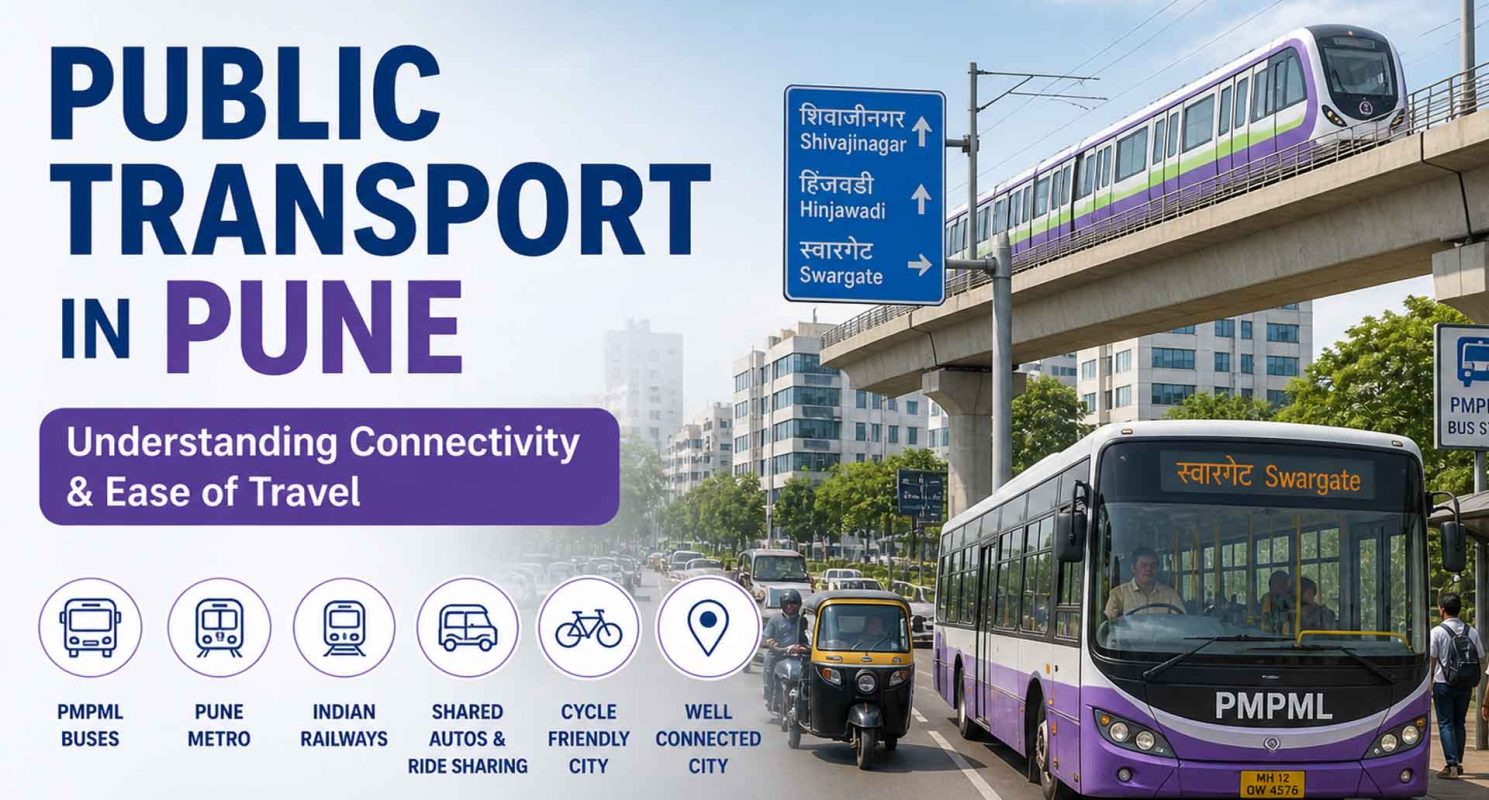
The thing about public transport in Pune is that it’s not bad—it’s just dramatically uneven depending on where you work and when you commute. Two metro lines are operational, a third is in phased rollout, and Pune’s bus network is undergoing its most significant expansion in years.
But “expansion underway” and “working reliably today” are two different things. This Pune commute guide breaks down what actually exists, what’s genuinely coming, and how to make smart housing and transport decisions in the middle of all that change.
What Public Transport in Pune Looks Like Today
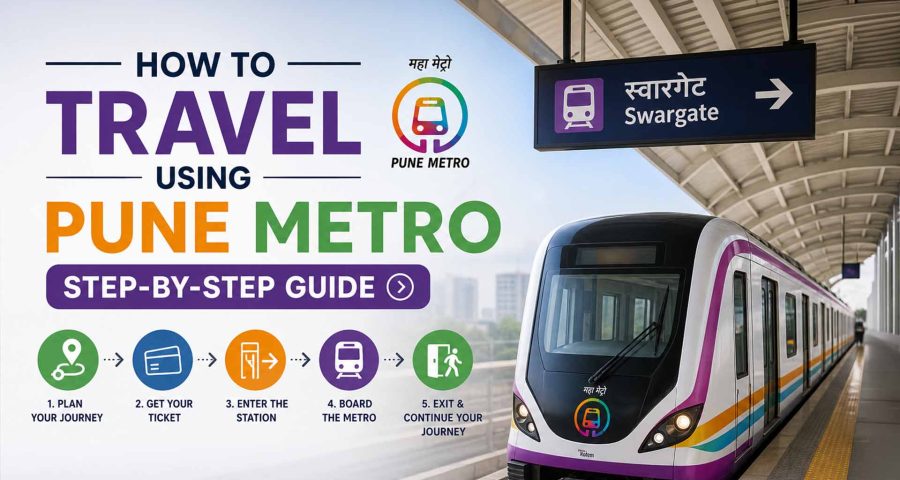
Pune Metro
Pune Metro: Two Lines Operational, One in Progress
As of early 2026, two metro lines are operational:
- Purple Line (PCMC to Civil Court, 16.6 km, 16 stations): Covers north Pune’s corridor through Kasarwadi, Bhosari, and Nashik Phata. Most useful for PCMC and Pimpri-Chinchwad-based professionals.
- Aqua Line (Vanaz to Ruby Hall Clinic, 14.7 km, 14 stations): Connects west Pune to central areas, useful for Bavdhan, Kothrud, and Deccan commuters.
Trains run 6 AM–11 PM, with increased frequency during peak hours (roughly 8–11 AM and 5–8 PM). Fares are distance-based, starting at ₹10 for short hops and scaling upward. Smart cards offer a modest discount.
The important caveat for Hinjawadi and Wakad professionals: neither current line reaches these areas. If your office is in Hinjawadi Phase 1, 2, or 3, the metro is not yet a daily-use option for you.
Metro Line 3 (Hinjawadi–Civil Court Corridor): In Phased Rollout
This is the line Hinjawadi professionals are waiting for. The Hinjawadi–Civil Court corridor is in a phased 2026 rollout, with the Hinjawadi Phase 1–Balewadi stretch expected to become operational during 2026. Full corridor completion, however, is still some time away. Treat this as a genuine near-term upgrade—not a current reality.
A PCMC–Nigdi extension to the Purple Line is also reported to be at an advanced construction stage, which would improve Pimpri-Chinchwad connectivity further, though confirmed timelines remain pending.
PMPML Buses
PMPML remains the most widely used public transport in Pune, running hundreds of routes across the city and handling millions of trips daily. For most working professionals, it’s the most practical option available right now.
What works today:
- Broad coverage across central Pune, PCMC, Baner, Wakad, and Kharadi
- Monthly passes are available for Pune and PCMC zones, making it cost-effective for regular commuters
- Real-time tracking is available via the PMPML app and Google Maps, though reliability varies by route and time of day
What’s still uneven:
- Frequency and punctuality remain inconsistent, particularly during peak hours and on high-demand IT corridor routes
- Fleet capacity hasn’t kept pace with Pune’s growth, resulting in crowded buses during rush hours
What’s planned (but not yet fully realized): Pune has announced the addition of new buses and routes specifically targeting IT corridors, including Hinjawadi, Wakad, and Kharadi. These additions are described as underway, but full rollout and consistent service quality should be treated as a work in progress rather than a completed upgrade. Verified timelines aren’t yet confirmed publicly.
Metro Phase 2: Approved, Not Yet Under Construction
Two new corridors totalling approximately 31.6 km received state approval in early 2026:
- Kharadi–Swargate–Khadakwasla corridor: Would directly connect Kharadi IT park to south Pune residential areas—a meaningful upgrade for east Pune professionals. Completion is expected post-2027 at the earliest.
- Nal Stop–Warje corridor: Would improve western Pune connectivity.
Tendering for both corridors was expected to begin in the months following approval. These are significant, funded projects—but for anyone making housing decisions today, they represent future optionality, not current infrastructure.
Which Public Transport Works Best by Area?
This is the most practical question for anyone relocating to Pune, and the answer varies significantly by location.
| Area | Best Option Today | What’s Coming |
|---|---|---|
| PCMC / Pimpri-Chinchwad | Purple Line metro + PMPML buses | Purple Line extension (advanced stage) |
| Central Pune / Deccan / Kothrud | Aqua Line metro + PMPML | Nal Stop–Warje corridor (post-2027) |
| Baner / Aundh | PMPML buses, autos | Metro Line 3 (Balewadi stretch, 2026) |
| Wakad | PMPML buses, autos, personal transport | Metro Line 3 nearby stations (phased 2026) |
| Hinjawadi Phase 1/2/3 | Company shuttles, PMPML, autos | Metro Line 3 Phase 1 stretch (2026 rollout) |
| Kharadi | PMPML buses, autos, cabs | Kharadi–Swargate metro corridor (post-2027) |
Best Daily Commute Setups in Pune
There’s no single “best” way to navigate public transport in Pune. Most professionals end up using a combination of options depending on distance, office location, and time of day. Here are the setups that actually work in practice:
- Metro + Auto (Central Pune)
If you’re living around Deccan, Kothrud, or PCMC, this is one of the most efficient combinations. Use the metro for the long stretch, then an auto for the last 1–3 km. It balances speed and predictability, especially during peak hours.
- Bus + Walk (Short Distances)
For commutes under 5–6 km, PMPML buses combined with a short walk are often the simplest option. It’s cost-effective and works well in areas with dense stop coverage like Baner, Aundh, and parts of Wakad. - Shuttle + Bike (Hinjawadi)
Many IT companies operating in Hinjawadi run shuttle services from key pickup points. Pairing this with a short bike ride or auto trip to the pickup location is often more reliable than depending entirely on Pune metro buses right now.
- Bike-Only (Wakad Proximity)
If you’re staying in Wakad, especially within a few kilometers of Hinjawadi Phase 1–3, a personal bike or scooter is often the fastest and most flexible option. You avoid waiting times and reduce dependency on still-evolving public systems.
The broader takeaway from this Pune commute guide: mix and match based on your route. Flexibility matters more than sticking to a single mode.
What Your Daily Commute Actually Costs
When evaluating public transport in Pune, most people focus on routes and availability. What often gets missed is the monthly cost impact of your daily commute.
| Mode | Monthly Cost (Approx.) |
|---|---|
| PMPML (bus pass + occasional extras) | ₹1,500–2,000 |
| Auto-rickshaws (regular short trips) | ₹2,000–4,000 |
| Bike/scooter (fuel + maintenance) | ₹2,500–4,000 |
The gap doesn’t look huge at first—but it adds up over time, especially when combined with long commute durations. For example, choosing a cheaper rental farther from your office often shifts costs into transport without reducing total monthly spend meaningfully.
Yukio Tip: Always evaluate commute cost alongside rent. In many cases, living closer to work reduces both time and overall monthly expenses, even if the rent is slightly higher.
Apps and Tools That Actually Help
A few tools genuinely improve the daily commute experience in Pune:
- Google Maps: Combines metro and PMPML routing and is generally the most reliable starting point for planning multi-modal commutes. Real-time accuracy varies, but it’s the best freely available option.
- Moovit: Useful for PMPML bus tracking and route discovery. Works better in central Pune than in outer IT corridors, where data can lag.
- PMPML Official App: Useful for pass management, route lookup, and official updates. Tracking reliability is improving but inconsistent—cross-check with Google Maps for live commutes.
- Pune Metro App: Best used for metro timings, smart card top-ups, and station maps. Straightforward and functional.
- Ola / Uber / Rapido: Worth keeping as a backup for last-mile gaps, particularly the 1–3 km stretch between metro stations or bus stops and office campuses. Rapido bike taxis are often the fastest option for short last-mile hops during peak hours.
A practical habit: plan your route on Google Maps, verify live bus status on Moovit, and keep a cab app ready for days when the timing doesn’t work out.
Yukio’s Take On Public Transport in Pune
Public transport improvements are real and meaningful—but they accrue differently depending on where you live today. The 2026 PMPML expansion and Metro Line 3 rollout benefit Hinjawadi and Wakad professionals most in the near term. The Phase 2 metro corridors are a longer-horizon story for Kharadi and south Pune.
The smarter approach: choose housing that reduces your transport dependency while infrastructure catches up, rather than housing that bets entirely on future connectivity.
That’s where Yukio Coliving in Hinjawadi and Wakad fits naturally into this picture. Being 3–5 km from major IT campuses means your daily commute doesn’t depend on whether the new bus routes have launched yet or whether the metro station nearest you is operational.
Fully managed living—meals, housekeeping, Wi-Fi, power backup—means zero mental bandwidth spent on logistics while Pune’s transport infrastructure catches up. And when Line 3 is fully running, you’re already well-positioned to use it.
Ready to Commute Smarter?
Pune’s public transport is genuinely improving—but it rewards those who plan around today’s reality, not tomorrow’s promises. Pick your location based on what works now, keep the right apps handy, and treat the upcoming metro expansion as upside rather than assumption. The commute gets easier when your starting point is already close to where you need to be.
Frequently Asked Questions
How much does it cost to use Pune metro buses monthly?
PMPML monthly pass costs ₹1,500 (covers Pune + PCMC zones), giving unlimited rides across 381 routes. Daily passes are ₹70. For Hinjawadi-Wakad commuters, this plus occasional autos (₹500/month) totals ~₹2,000 vs ₹3,000+ for two-wheeler fuel/maintenance
Which public transport options work best for Hinjawadi IT professionals?
Currently, PMPML buses (Route 326 Jadhavwadi-Chikhali) are the most reliable. Metro doesn’t directly reach Hinjawadi yet; the PCMC-Nigdi extension, completing in December 2026, will improve northern access. The 100 new PMPML routes launching in 2026 will enhance Hinjawadi connectivity significantly.
When will Pune’s new metro corridors be operational?
The Kharadi–Swargate–Khadakwasla and Nal Stop–Warje corridors (31.6 km, 28 stations combined) received state approval in February 2026. Construction tendering is underway; completion expected post-2027. Current metro lines (Purple, Aqua) are fully operational, covering 31 km.